What Is Tae Kwon-Do?
Tae Kwon-Do is an ancient Martial Art, which comes from Korea.
Tae Kwon-Do Oath
As a student of Tae Kwon-Do I do solemnly pledge to abide by the rules and regulations of the Tae Kwon-Do Association, to strive always to be modest, courteous and respectful to all members, in particular my seniors, to put the art into use only for self defense or in defense of the weak and never to abuse my knowledge of the art.
Tenets of Tae Kwon-Do
COURTESY
INTEGRITY
PERSEVERANCE
SELF CONTROL
INDOMITABLE SPIRIT
Rules of The Dojang
No smoking inside the Dojang
No gum chewing
No jewelry may be worn during classes
No shoes to be worn in the Dojang at any time
Student must never leave class for a break, water or an early dismissal without permission
Never loose your temper in the Dojang - especially during sparring
Never lean on walls or lay spread out on the floor unless while exercising
Student must keep finger and toenails clipped short and clean
Keep your uniform clean at all times
No horse-play, whistling or loud talking in the Dojang
No talking during class except to ask a question
Before asking a question raise your right hand to attract the instructors attention
While in the Dojang, always address the instructor as "Sir" or "Mr." using the instructor's surname
Student should behave in a disciplined manner while training
Bow to the flag before entering or leaving the Dojang
Respect all members of senior grade
While fixing your Dobok or belt do not face your instructor
Any student who is late for class must get instructor's permission and bow to the instructor before joining the class
The Interpretation of Patterns
CHON-JI:
means literally "the Heaven the Earth". It is, in the Orient, interpreted as the creation of the world or the beginning of human history, therefore, it is the initial pattern played by the beginner. This pattern consists of two similar parts; one to represent the Heaven and the other the Earth.DAN-GUN:
is named after the holy Dan-Gun, the legendary founder of Korea in the year of 2333 B.C.DO-SAN:
is the pseudonym of the patriot Ahn Chang-Ho (1876-1938). The 24 movements represent his entire life which he devoted to furthering the education of Korea and its independence movement.WON- HYO:
was the noted monk who introduced Buddhism to the Silla Dynasty in the year of 686 A.D.YUL-GOK:
is the pseudonym of a great philosopher and scholar Yi I (1536-1584 AD) nicknamed the "Confucius of Korea". The 38 movements of this pattern refer to his birthplace on 38 degree latitude and the diagram represents "scholar".JOONG-GUN:
is named after the patriot Ahn Joong-Gun who assassinated Hiro- Bumi Ito, the first Japanese governor-general of Korea, known as the man who played the leading part in the Korea- Japan merger. There are 32 movements in this pattern to represent Mr. Ahn’s age when he was executed at Lui-Shung prison (1910).TOI -GYE:
is the pen name of the noted scholar Yi Hwang (16th century), an authority on neo- Confucianism.HWA-RANG:
is named after the Hwa-Rang youth group which originated in the Silla Dynasty in the early 7th century. The 29 movements refer to the 29th Infantry Division, where Tae kwon-Do developed into maturity.CHOONG-MOO:
was the name given to the great Admiral Yi Soon-Sin of the Lee Dynasty. He was reputed to have invented the first armored battleship (Kobukson) in 1592, which is said to be the precursor of the present day submarine. The reason why this pattern ends with a left-hand attack is to symbolize his regrettable death, having no chance to show his unrestrained potentiality checked by the forced reservation of his loyalty to the king.Time Between Gradings
|
Grade (Kup & Dan) |
Time Till Next Grading |
|
10th Kup to 4th Kup |
Three Months |
|
3rd Kup to 1st Dan |
Six Months |
|
1st Dan to 2nd Dan |
Two Years |
|
2nd Dan to 3rd Dan |
Three Years |
|
3rd Dan to 4th Dan |
Four Years |
|
4th Dan to 5th Dan |
Five Years |
|
5th Dan to 6th Dan |
Six Years |
Grade and Belts

10th Kup
= White signifies innocence, as that of a beginning student who has no previous knowledge of Tae Kwon-Do
9th Kup


8th Kup
= Yellow signifies Earth, from which a plant sprouts and takes root as the Tae Kwon-Do foundation is being laid. 
7th Kup


6th Kup
= Green signifies the plant's growth as the Tae Kwon-Do skill begins to develop. 
5th Kup

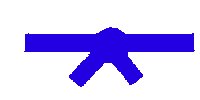
4th Kup
= Blue signifies the Heaven towards which the plant matures into a towering tree as training in Tae Kwon-Do progresses.
3rd Kup

2nd Kup
= Red signifies danger, cautioning both the student to exercise control and the opponent to stay away.
1st Kup
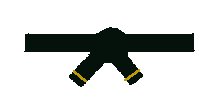
1st Dan
= Black, the opposite of white, signifies maturity and proficiency in Tae Kwon-Do. It also signifies the wearer's imperviousness to darkness and fear.
2nd Dan
And then the Black belts just go up the Dan's and with each Dan there is a new gold stripe on the belt.